
-
 February 4, 2026
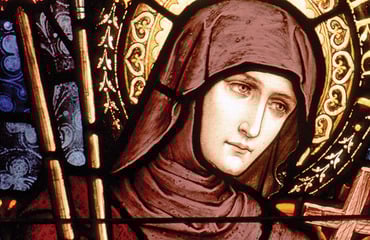
Saint Margaret of Cortona was a converted public sinner, a Franciscan tertiary, and mystic. Margaret was born to a farm family in 1247 in the village of Laviano in the Tuscany region of Italy. Her mother died when she was seven and her father soon remarried. Pampered and willful, Margaret was in constant conflict with her stepmother. With time, the conflict grew to be verbal abuse from the stepmother, and the beautiful flirtatious teenage Margaret spent most of her time in the town and away from home.
At seventeen, she ran off with a nobleman, thinking she had found her path to a life of luxury as his wife. He took her to his grand castle at Montepulciano, where she settled in not as his wife, but as his mistress. She lived thus for nine years and had a son with him. She pled with her paramour to marry her, but he broke several promises to do so. One day, the man set off on a journey with his dog and did not return as expected. Finally, the dog came home alone, and it led Margaret to the man’s brutally beaten body, the victim of a crime. Recognizing her need to repent of her sinful ways, she left her possessions in the castle and set out for home with her little boy. Upon her arrival, she undertook public acts of penance for her public sins, which was humiliating to her father and stepmother, and they refused to let her stay.
Margaret knew that there were some Franciscan friars in the nearby town of Cortona, and she went there seeking mercy and help. The friars found shelter for her with two women, and she again made a public confession of her sinful past life. She moved into a small cottage with her son, lived on alms, and she took care of children and provided care for sick people. After a three-year period of probation, she became a Franciscan tertiary, or member of the Third Order and was able to wear a habit. Struggling with self-hatred, severe temptation, and spiritual aridity, she applied herself to the most severe mortifications imaginable, including starvation. She attempted to cut her face to mar her beauty but was stopped by her spiritual advisor who urged her to modify her penances. Deeply grieved by the likelihood of her former lover’s death outside a state of grace, she dedicated the rest of her life to prayer on behalf of the souls in purgatory.
Beginning in 1277, Margaret had mystical experiences where she would go into an ecstasy and speak with the Lord, Who called her His “poverella” or little poor one. She was given messages from Him, some for her own edification and some to be shared, which were recorded by Father Giunta, her spiritual advisor.
With time, Margaret founded a hospital in Cortona for the sick poor. She began a congregation of women to provide care for the patients, a group of Tertiary sisters known as Le Poverelle. She also established Our Lady of Mercy, a confraternity created to support the works of the hospital. She herself provided spiritual counsel to guide people to repentance and restoration to a state of grace. Her reputation as a wise and holy woman spread and many sought her out. She also became known as a person who could bring reconciliation to feuding families. She openly criticized the local bishop for his worldly ways and for living as if he was royalty. By 1288, she desired a more contemplative living situation and went to live in the ruins of a small Basilian chapel, damaged by warfare. She led efforts to repair the chapel and spent the remainder of her life there. She welcomed sick and injured people, for whom she worked miraculous healings. She died February 22, 1297 at age forty-nine. Just before she died, she had a vision of a large number of souls, whom her prayers had released from purgatory. Within forty years of her death, the people of Cortona, in her memory, built a beautiful church around the original chapel, called Santa Margherita. When her body was exhumed in the fifteenth century, it was discovered to be incorrupt and remains so to this day.
St. Margaret of Cortona is sometimes known as the second St. Mary Magdalen or Magdalen of the Seraphic Order, a tribute to her full and permanent conversion after a sinful past. She was responsible for numerous conversions and was sought for her miraculous healings and spiritual advice from people all over Italy, France and Spain. Her son became a Franciscan friar. Margaret was canonized in 1728. She is the patroness for many causes, including the homeless, single mothers, reformed prostitutes, and midwives. Her feast day is February 22.