
Search
-
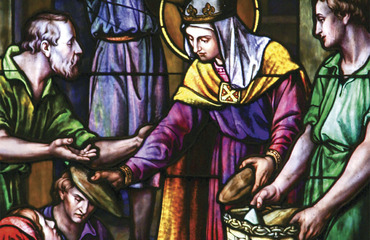 November 1, 2025St. Margaret of Scotland was a wife, mother, queen, patroness, and reformer. In 1045, Margaret was born a princess, the daughter of the Anglo-Saxon Prince Edward d’Outremer and Princess Agatha, who was the daughter of King Edmund Ironside. At the time of Margaret’s birth, the Danes were controlling much of England and her parents were living in exile in the court of Stephen, King of Hungary. She grew up and was well-educated there. When Margaret was twelve, her father was called back to England by King Edward the Confessor, also an eventual Saint, who had no heir. Margaret’s father died just after their arrival, and his widow and her three children remained at the Court of King Edward. After the 1066 Battle of Hastings, William the Conqueror, a Norman, became king, and Agatha and her children sought refuge further north. Their ship was taken to Scotland in a storm, and the family was welcomed in the Court of King Malcolm III of Scotland.
A NEW VOCATION
King Malcolm, who was widowed, wanted to marry Margaret, a member of the Royal House of Wessex. Although she had wished to enter religious life, Margaret eventually agreed to marry Malcolm, and the couple wed in 1070 at Dunfermline Castle. Margaret was intelligent, refined, and a very capable leader, as well as pious and charitable. She had a great influence on her illiterate and rather crude husband, teaching him Scripture and prayer. He had a beautiful, bejeweled book of the Gospels made for her and truly appreciated her sincere piety and the genteel touches that she brought to the Court. She devoted herself to initiating synods to reform the Scottish/Celtic Church to be more in conformity with the practices of the Continent, establishing proper marriage practices and suppressing usury and simony. Her commitment to literacy, prayer, and fasting was spread throughout the royal court, bringing a true change of culture there and in the country at large. She also devoted herself to promoting education and the fine arts. Margaret was an accomplished embroiderer and set up a “workshop of sacred art” in the castle for the making of beautiful vestments and altar cloths.
HUMILITY AND CHARITY
It was Margaret’s commitment to helping the poor that made her so beloved and is her most famous legacy. She would invite beggars and orphans into the castle, where she would feed them from her own table and provide clothing for them before she herself had eaten. She would also wash their feet, a practice in which King Malcolm eventually joined her. To make pilgrimages to St. Andrews possible, she had a ferry made for crossing a river. She founded the Abbey at Dunfermline, as well as other churches, and had a chapel made in Edinburgh Castle.
King Malcolm and Queen Margaret had a happy and loving marriage, and they had eight children together. One daughter married the King of England, and three of her sons in succession inherited the Scottish throne; one of whom, David, is also a saint. Margaret, always committed to fasting and austerity, damaged her health. By the time she was forty years old, she was permanently ill. It was King Malcolm’s efforts to expand his kingdom into England that brought turmoil and bloodshed to the land. During the Battle of Alnwick in Northumberland, Malcolm fell prey to an ambush and surrendered. Despite his surrender, he was killed on November 13, 1093, and soon after, so was his son Edward. When Margaret’s son Edgar brought her the news of the death of both her husband and her oldest son, she died within days, on November 16 at age forty-eight. At the time of her death, Edinburgh Castle was under siege, so her body was taken to Dunfermline and buried beneath the altar. Witnesses stated that her body emanated a pleasant fragrance. When Protestantism arose in England, Margaret’s relics were divided and eventually lost, save one piece which is housed at Edinburgh.
THE PEARL OF SCOTLAND
St. Margaret of Scotland, often referred to as “The Pearl of Scotland”, was a noble, pious, and generous woman. She used her place in society to do great good – a rare saintly queen. Most of what we know about her came from her spiritual advisor, Bishop Turgot of St. Andrews. Margaret’s daughter Matilda, who had married King Henry I of England, requested that the bishop write her biography. While Margaret’s relics are almost all lost, the beautiful book of the Gospels that King Malcolm had made for her is kept in a library at Oxford. Margaret was canonized in 1250, and she is the patroness of Scotland. Her feast day is November 16.