
Search
-
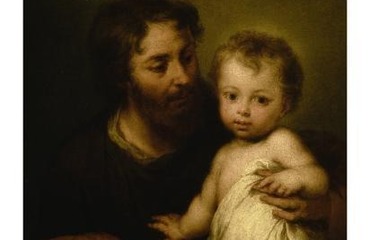 December 2, 2025St. Joseph was a carpenter, a husband and foster father, and the guardian of the Holy Family. The only things we know about this mysterious and beloved saint is what is contained in the first two chapters of the Gospels of St. Luke and St. Matthew. In those Infancy narratives, Joseph is a carefully documented descendant of King David, of whose line the prophesied Messiah was to come. His ancestry was from Bethlehem in Judah, but he was living in Nazareth in Galilee, where he worked as a carpenter or wood worker. On three occasions, he was told what to do by an angel: to know that the pregnancy of the Virgin Mary had a divine origin and that he was to take her into his home, that the Divine Child’s life was in danger and they were to flee to Egypt, and that Herod the Great had died and it was safe to return to Nazareth. St. Matthew declares Joseph a “just man”, a very rare compliment in Scripture. No words of his are recorded in the Gospels, nor any mention of his death. Since Our Lord gave guardianship of His Mother to [St.] John the Apostle at the time of His death, it is likely that Joseph died before Jesus left home to begin His public ministry. While St. Joseph is often depicted in artwork as an elderly man in an effort to protect Mary’s perpetual virginity, it is likely that he was a man in the prime of life. Ven. Fulton Sheen wrote, “Somehow, the assumption had crept in that senility was a better protector of virginity than adolescence. Art thus unconsciously made Joseph a spouse chaste and pure by age rather than by virtue.” It is also unlikely that Jesus’s Scriptural “brethren” were the products of a previous marriage of Joseph, rather than being His first cousins. One of the people present at Calvary was the Virgin Mary’s “sister Mary”. Since Our Lady would not likely have a sister with the same name, that Mary was related to either Joseph or Mary, and was the mother of the Apostles James [the Less] and Jude Thaddeus. Joseph’s absence from Jesus’ trial by the Sanhedrin also strongly points towards his prior death.
Devotion to St. Joseph was more prevalent in the Eastern Churches but spread to the Church in Europe in the fifteenth century. In 1479, his feast day was established in the Roman calendar. He was named the Patron of the Universal Church in 1870. Pope Benedict XV named him as the protector of workers. In 1955, as a statement against the grave errors of Communism, [Ven.] Pope Pius XII initiated the May 1 feast day of St. Joseph the Worker. This gave St. Joseph the honor of having two distinct feast days, an honor he shares with Sts. John the Baptist, Peter, and Paul. Many of the saints have had great devotion to St. Joseph and appreciated his patronage. Most notable among them were Sts. Francis of Assisi, Teresa of Avila, Peter Julian Eymard, and Andre Bessette. St. Andre worked to have built the largest church in the world under his patronage, the beautiful St. Joseph’s Oratory in Montreal, Canada.
St. Joseph has appeared in several Church-approved apparitions over the centuries. St. Gertrude the Great had a visit from the Virgin Mary, who told her of St. Joseph’s great glory in heaven. St. Teresa of Avila said that he appeared to her and gave her encouragement and advice. Most notably, there was a two-hour apparition in 1879 at Knock, Ireland, witnessed by fifteen people. No words were spoken, but Joseph appeared with the Virgin Mary and St. John the Apostle/Evangelist. Most recently, St. Joseph was part of the 1917 Fatima apparitions, appearing during the October 13 “Miracle of the Sun”. While the apparition was not witnessed by the large crowd as they watched the sun spin and dance, the Fatima children saw him with the Child Jesus and Mary.
When thought is given to St. Joseph’s wordless actions, it is apparent why he is so venerated and beloved. He was an ordinary man who worked with his hands. His swift actions in response to the prompting of an angel reveal that he must have been a man of great faith and devoted prayer. Due to his fleeing with the Holy Child and His Mother to escape the malice of King Herod the Great, Joseph is sometimes called the “savior of the Savior of the world.” His humility is extraordinary, considering that he knew that he was the putative father for the Christ, yet had to remain silent for long years about the identity of his Child. Numerous exorcists have stated that he is feared by demons second only to the Virgin Mary, because of his great purity and humility, and has thus earned the title “Terror of Demons.” Most especially, he was chosen by God for the extraordinary honor of being the provider and protector for the Second Person of the Holy Trinity and of the Immaculate Virgin. In art, Joseph is commonly depicted by himself holding either the Divine Child, a lily or a staff that has bloomed with lilies for his purity, or a carpentry tool. Countless works of art depict him present at all the scenes described in the Gospels between the Annunciation and the finding of the Child Jesus at age twelve in the Temple. Many depictions also show him in his woodworking shop, teaching Jesus his trade. Traditional piety portrays Joseph dying in the arms of Jesus and Mary, making him the patron of a happy death. St. Joseph’s primary feast day is March 19, and he is also the patron of fathers, travelers, immigrants, and families.