
Search
-
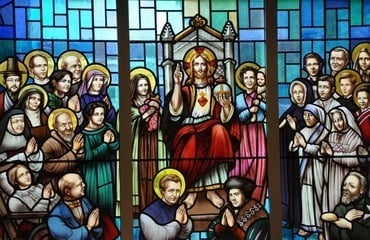 February 4, 2026“The greater the charity of the saints, in their heavenly home, the more they intercede for those who are still on their journey and the more they can help them by their prayers; the more they are united with God, the more effective those prayers are. This is in accordance with divine order, which makes higher things react upon lower things, like the brightness of the sun filling the atmosphere.” St. Thomas Aquinas (13th century Doctor of the Church)
"Remember that you will derive strength by reflecting that the saints yearn for you to join their ranks; desire to see you fight bravely, and that you behave like true knights in your encounters with the same adversities which they had to conquer, and that breathtaking joy is theirs and your eternal reward for having endured a few years of temporal pain. Every drop of earthly bitterness will be changed into an ocean of heavenly sweetness." Bl. Henry Suso (14th century)
“Considering that when the saints lived in this world, they were at liberty to roam the earth, do you really think that in heaven God would have them tied to a post?” St. Thomas More (15th-16th centuries)
“O blessed souls who with this precious price knew so well how to profit and buy an inheritance so delightful and permanent, tell us how you gained such an unending good! Help us, since you are so near the fount; draw water for those here below who are perishing of thirst.” St. Teresa of Avila (16th century, Doctor of the Church)
“I shall be able to do much more for you in heaven than I can now while I am on earth.” St. Pio of Pietrelcina (19th-20th centuries)
“We hardly think about reparation any more. We seem to have dropped it in the Church. We have reparation in the human body. When I had my open-heart surgery, I was bleeding to death. I depended upon eighty people who gave me eighty pints of blood. The human body has only eight pints. Volunteers had to supply eighty pints to keep me alive. They were filling up the quota of my life. And just as we have a kidney transplant, even a heart transplant, so we have the transplanting of merits, of prayers, and sacrifices from one member of the Church to the other, to cure those members of their anemic condition.” Ven. Fulton Sheen (19th-20th centuries)
“Since we are united to Christ in the Mystical Body and form one organism with Him, any achievement in our spiritual life has a supernatural value, not only for us as individuals, but also for the entire Church. The dogma of the Communion of Saints makes the social solidarity of people something real in a very profound way. Because of it our merits are a common good and can be exchanged or transferred to others. This refers to prayer as well as all acts of mercy, and most of all to suffering. Christ Himself, sitting at the right hand of God the Father...cannot suffer. However, as the Head of the suffering Body He too suffers. That suffering is borne in His stead by countless individuals into whom sanctifying grace flows as a life-giving sap, and who thus fill up those things that are wanting of the sufferings of Christ for His Body which is the Church. In this way they partake of the mercy brought to the world by the sufferings of Christ. At times, after they have paid out to God the debt for their own faults, they are permitted the great honor of suffering with Christ for the sins of others...The countless chosen souls who...through their saintly life, prayer, mortification, Christian apostleship and suffering, appease the wrath of God and obtain His mercy for the world.” Servant of God Hyacinth Woroniecki (20th century)
“Live a special communion of the saints, and at the moment of interior struggle, as well as during the long hours of your work, each of you will feel the joy and the strength of not being alone.” St. Josemaria Escriva (20th century)
“Even when they reached heaven, the apostles continued to assist the world. In fact, they now do more since their work is no longer hampered by the physical constraints of this life.” Ven. Francis Xavier Nguyen Van Thuan (20th-21st centuries)